![[ a literary magazine ]](http://images.squarespace-cdn.com/content/v1/65b4141941f0433ece4beddb/ea269048-459a-4765-bbef-4b6ed15f44f3/driplogoISSUE9header.jpg?format=1500w)
[ Joey Junsu Hong ]
*The geographic settings and events in this work are drawn from real life. For the sake of anonymity, the character’s name and occupation have been changed or intentionally obscured.
Nonbinary Romance in a Time Against Love, Notes on Situationships
1.
At the beginning of 2025, I decided to spend my whole winter break in Los Angeles: to avoid the Midwestern winter apocalypse and to quench my thirst over big cities. Unfortunately, the real LA was pretty different from what I dreamed of. Beyond the small downtown stretch near Koreatown, LA seemed like an endless sprawl of suburb. I even started to miss the cold and snow of the Midwest, thereby decided to cut my trip short. However, right after I changed my flight, a game changer happened: I met a guy named Jade on Tinder. I messaged him, and he responded in a very friendly manner. I remember him asking, “Are you visiting LA?”, “Awww for how Long?”, “Will we have a chance to meet?” At first, I did not expect much. Casual dates are not bad, especially when you are travelling. A fun uplifting dinner that will ease suburban boredom—that was what I expected, no more. That was the very beginning of my situationship with Jade. Only later did I realize that the ambiguity of situationships was not unique to us. It was part of a larger pattern embedded in our culture, almost like a subtle game of give and take that shapes who gets close and who stays distant.
2.
We, the inhabitants of the twenty-first century are living in a time against love. We want the thrill, but the price of love feels too steep. Situationships, an increasingly prevalent form of relationship in contemporary dating scenes, are typically marked by the absence of clear definitions, labels, or real commitments. This lack of clarity can emotionally and sexually exploit the individuals involved, confining them in the realm of persistent suspicion of their partner(s). Although it may sound ironic, this short time I spent with Jade left me wondering if freedom in romance can ever exist without responsibility. This essay is, in part, a memoir of that brief connection.
3.
Jade was a guy living in Los Angeles who worked in the healthcare industry. He was five years older than me, and he drove all the way from the California coast to Alhambra to pick me up. Unexpectedly, the date turned out to be much deeper than superficial. It all started with a simple gesture of holding hands while Jade was driving. As I was about to leave California in three days, I thought that night might be the first and the last hang out for us, so I wanted to try something special—which led Jade and I to have a fauxmance: a fake relationship. I carefully asked whether he wanted to hold hands. He seemed surprised first at my straightforwardness but soon agreed to my idea of enjoying abrupt intimacy. Having damaged from previous situationship, my date with Jade over two days came off as rewarding than exciting—the feeling we want from romantic relationships, which is the feeling of being recognized as a special being: “I picked you and you picked me.”
What particularly drew me to Jade was the sense of recognition as a nonbinary genderqueer person. Jade and I had dinner at a small Japanese restaurant at Little Tokyo. I told him that I had been to California before for a conference that happened at Palm Springs. I showed him a photo of me presenting. He zoomed into the photo, trying to read what was written on my slides. Then, he noticed that I use they/them pronouns, written in parenthesis right next to my name. He exclaimed, “Oh! You use they pronoun. I’m so sorry.” That light but genuine apology left a mark inside me. Of course, getting an apology for misgendering happened and still happens to me quite often. However, it hits different when it happens at a date.
For a nonbinary person, dating is navigating awkward disclosures or, at times, concealing your “true” gender identity, which involves emotional labor that others rarely notice. I have always dealt with the unsettling possibility that even someone who appeared to be kind and interested might not stay if I assert my identity. I call this Second-Out. When someone assumes that I am cis queer, usually gay, but I need to clarify my actual identity. I have encountered a few cis gay guys who were not pleased to learn about my genderqueer identity. The worst were guys who did not even care to learn what nonbinary even means. That attitude came off a denial of who I am. I was never a deceiver in my life. However, due to the incongruence between my look and my preferred gender identity, some guys ended up thinking that I fooled them. It was not my intention to let Jade know about my pronouns. He amazed me by not asking any questions about pronouns. I was still me even after my involuntary Second-Out. Jade’s apology gave me a glimpse of queer intimacy with dignity. I was finally legible to someone without overexplaining myself!
The rest of the evening was cute: great meals, awesome bread pudding laced with Blue Moon, and a stroll around Santa Monica Pier, our fingers linked in public. The intense intimacy I felt from a simple gesture of holding hands seemed like a reward for all the other shitty dates I had. Being so high with the romantic moment, I forgot to make it clear regarding what Jade wanted to do with this “fake relationship.” We both agreed that we had a great time. Nevertheless, we differed, or so I came to believe, in what we imagined might follow. Although I did not expect much from this relationship that serendipitously emerged, I thought both of us would develop it into something more meaningful and long-term by keeping in touch with one another. Contrary to my belief, Jade drifted away from me once I returned to my hometown. He began replying lesser and lesser, in short and distracted bursts. His replies trickled in in a brief, distracted, apologetic manner. He said he was catching up on sleep. That he was busy. The problem was, he behaved in a tricky way by keep sending mixed signals to me. While he was not very good at texting and checking in, he still made me feel giddy by remembering my big days, like my presentation, saying some sweet words like “You are special, remember?”
Since I wanted to continue the intimate connection, I asked whether I would be able to see him again and spend some time together if I visit San Francisco during spring break. At first, Jade told me that his license examination was scheduled right after the break. Despite this tight schedule, he eventually said that he would come up to San Francisco to see me. I took his affirmation as a sign that he was still interested in me. However, things started getting tougher and tougher. At times, it took more than three days for him to return my text messages. He seemed nonchalant and avoidant, which made me feel that I was dealing with a totally different person than the one I met in LA.
One day, Jade I had a phone call. I was able to sense that he was not excited about our reunion nor he was being honest about his feelings. During that conversation, I said I really wanted to visit the Golden Gate Bridge. To my wish, he showed a reaction that almost felt dismissive. All he said was, “Yeah, a lot of people do that.” My gut feeling told me that something unpleasant was coming. I tried to hold on to my ambiguous relationship with Jade, not simply because I liked him a lot but I did not want to lose the possibility of being embraced by my lover as a nonbinary person. For genderqueer folks, situationship breakup is not just the loss of romance. It is the loss of a space where we are tentatively, maybe almost, being accepted as who we truly are. I tried hard to stay focused on school work, and several days later, I got my plane tickets and a room to stay with Jade—only to be stood up by him on the very day of the trip.
On the first day of spring break, I got up early to catch a flight. It took about four hours and a half to get to the West Coast. While I was waiting for my connection in Los Angeles International Airport, Jade sent me a text message, which said that he really needed some extra time to study for the license exam. Calling that as a lame excuse would be an understatement. I was devastated. I texted him back, saying that I had something that I wanted to discuss in person. To this message, he showed an even more timid and avoidant attitude. His only reply was, “In-person? Why do I feel like I’m in trouble?” Under the excuse of being at work, he said he couldn’t talk to me. He did not get back to me until next morning. In fact, I had to text him again to make him speak. However, when I steered the conversation toward our undefined relationship, he fell silent again. I left a long voice message to make it super clear that I wanted clarity from him and it was not fair for him to make me wait for his response that may never come.
While waiting for his response, I wandered the Bay Area alone. Starting the second day, it rained all day, and the wind almost made it impossible to walk without breaking my umbrella. I tried to justify what happened by telling myself it was just as well our dates got canceled because of the weather. I paved my own way through the storm to see the Lombard Street and the Painted Ladies. The entire walk was a battle against “what-ifs” that were keep lingering in my mind: “Would things have been different if I asked him to see me after his exam?,” “Would my life have been easier if I had not met him in LA?” These “what-ifs” show that a relationship that has ended before it even began is so sinister, because the paranoia often persists long after the relationship is over.
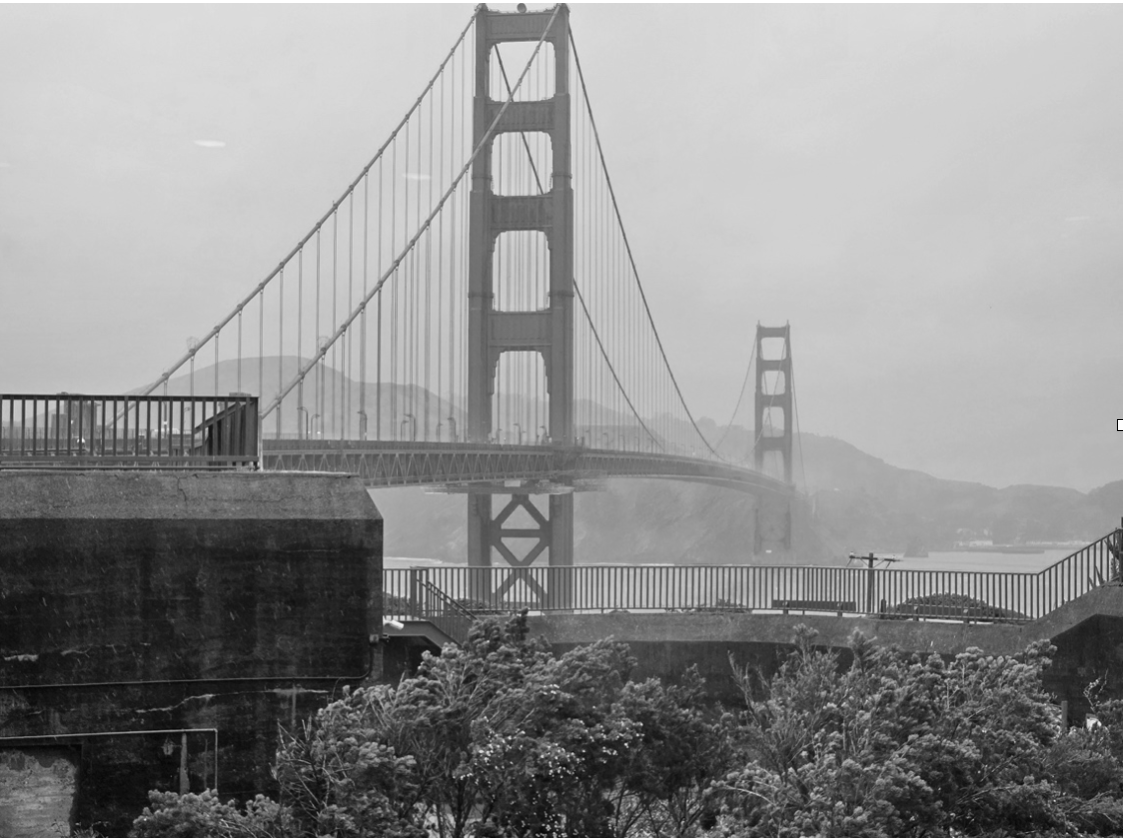
Despite these paranoid thoughts as well as the fog and the wind that tore through my umbrella, I arrived at the Golden Gate Bridge at last. For a moment, I stood still. The silence returned. I realized that silence was Jade’s final answer. Like I did in Los Angeles, I changed my flight to leave the next day.
4.
As I briefly mentioned at the outset of my story, humans still want the thrill of love and a sense of romance. Situationship fulfills these superficial needs of human subjects in the post-romance era. bell hooks once wrote that “[m]any people want love to function like a drug, giving them an immediate and sustained high. They want to do nothing, just passively receive the good feeling … When the practice of love invites us to enter a place of potential bliss that is at the same time a place of critical awakening and pain, many of us turn our backs on love” (my emphasis). hooks saw love’s commodification as an ephemeral and narcotic experience that fails to transcend what she calls “critical awakening and pain.” Situationships initiate with intense excitement, subsequently relegating the remainder of the relationship to a permanent state of ambiguity without closure.
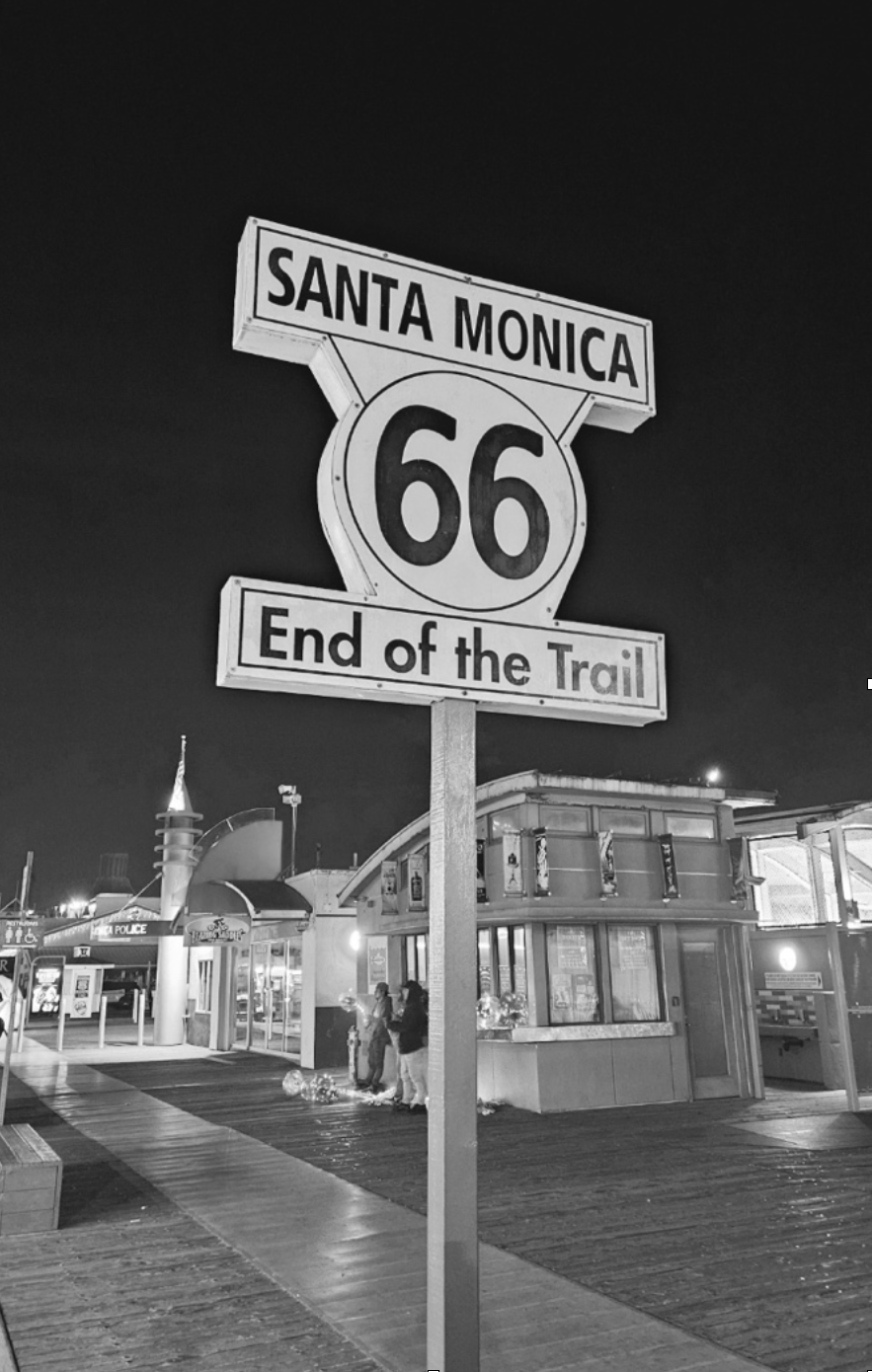
It was actually me who had to make a closure—the end of the trail. This Santa Monica 66 sign stayed with me. It was a reminder that endings are a kind of geography. I had arrived where I needed to stop walking towards Jade. The next morning, I received a long text message from him right before I got on the return flight. As expected, he said he could not commit to a long-distance romance or relationship although he understood where I was coming from. I told him that I did make it to the Golden Gate Bridge like I told him I would and I liked the Bay Area. That was my very last words for him. Hard days followed. The city kept replaying in me. I kept rewinding a moment he and I shared in his car: As we drove through the tunnel, Jade told me, “There’s a superstition that if you hold your breath till the end, your wish will come true.” It was childlike, absurd. And still, I held my breath. I wished for us to keep seeing each other—in any form. That wish did not come true. Although I failed to gain what I wanted, the aftermath gave me a strange kind of clarity: I no longer wanted the kind of ambiguity that asks nothing, promises nothing, and leaves everything in silence.
5.
This gravitation towards the ethical relationship speaks to Simone de Beauvoir’s existential ethics in The Ethics of Ambiguity, where she argues that “freedom realizes itself only by engaging itself in the world … he must try to conquer it.” For Beauvoir, freedom is not a permanent property; instead, she imagines it as something practiced, built, and shared. By this measure, situationships, rooted in withholding, ambiguity, and disavowal, fail to uphold the freedom of the Other. In fact, situationships reflect a neoliberal mode of intimacy, where desire is transactional and emotional responsibility is optional. To move through this paradox, we need to reframe love not as self-sacrifice, but as Erich Fromm reminds us in The Art of Loving, it is also self-empowerment. Love does not efface one’s self-identity, rather bolsters it, enabling one to practice care for others without completely relinquishing their own subjectivity.
Letting go of Jade was not just a good bye to him—it was also a farewell to a version of myself that had to hold on, who read into silences, who kept false hope, and justified romanticized ambiguity. Perhaps grief does not end with certainty. It ends with choosing to stop waiting. And so, I wrote. To turn what hurt me into words is to reclaim power over what once held me captive. This piece is not just a closure to my story with Jade—it is a quiet promise to myself that I will no longer remain in ambiguity where nothing arrives.

“Did you ever care for me that much, I don’t know. But that is all part of it and all we have known is only a
beginning. And it has been such a short time.”
-Patricia Highsmith, The Price of Salt (1952)
1 The term “situationship” was first used by a journalist Carina Hsieh in 2017 in her Cosmopolitan article that addresses the popularization of dating apps.
2 hooks, bell. All About Love: New Visions. William Morrow Paperbacks, 2018.
3 Beauvoir, Simone de. The Ethics of Ambiguity. Translated by Bernard Frechtman, Open Road Media, 2018.
Joey Junsu Hong is a creative writer and early career researcher in literature based in the Midwest. They write to give shape to feelings that resist containment such as shame, humiliation, and anger, believing that storytelling can soften the weight of undeserved suffering. Joey's works have appeared in Visible and other venues.