![[ a literary magazine ]](http://images.squarespace-cdn.com/content/v1/65b4141941f0433ece4beddb/6d93855c-757c-4c2a-8da6-6e483f266824/driplogoSECRETS.jpg?format=1500w)
Tomas with an X [ Gregg Williard ]
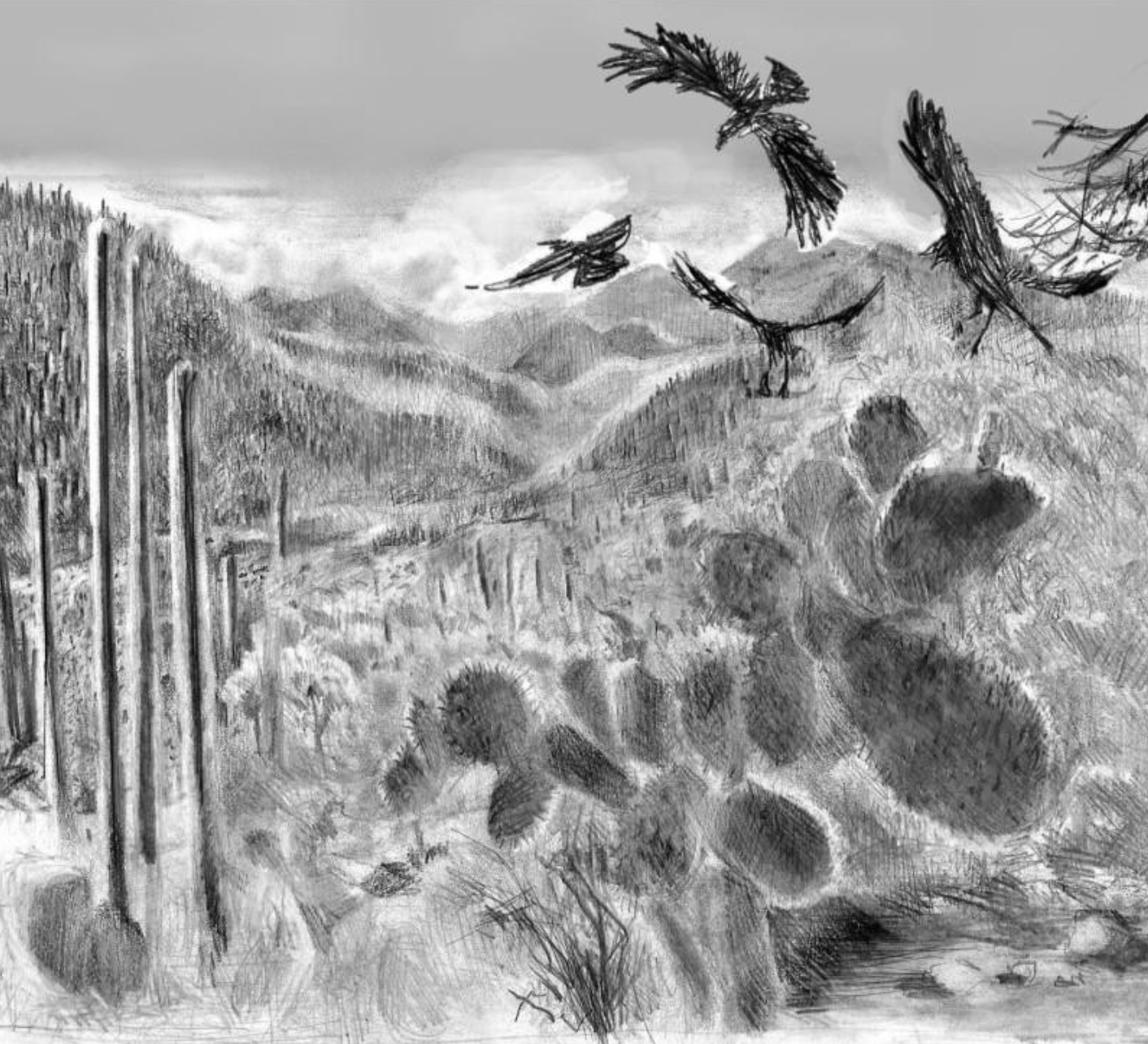
The road narrowed to the climb. Around a corner the van ahead stopped again. Some crows circled low and started cawing wild. I killed the siren and waited, watching the birds and hoping the van would leave. I decided not to follow anymore. There was no movement from the van. I got out, and dust kicked up around me and my ears rang with gunshots. I tumbled back into the car and the windshield exploded over my head.
“Oh, Jesus! Hey! I’m not really the police!” How did glass get in my mouth?
After a few seconds I heard high pitched laughter. “Just throw your gun out and we’ll let you go your way.” “Yes!” A higher voice said. “Go your way!”
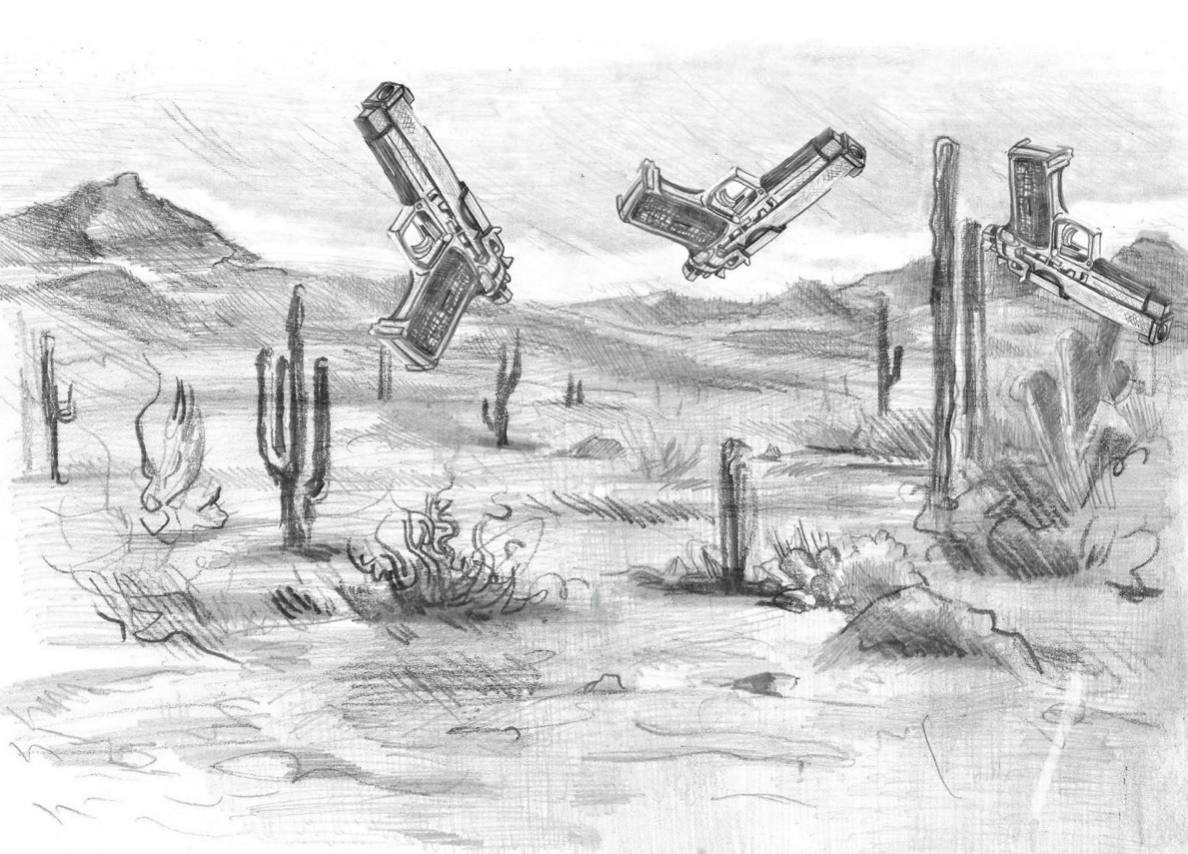
I threw out my gun. A thick man with a beard and a white shirt got out of the van. He was followed by a smaller man with shades and an assault rifle. The thick man scooped up the gun, checked the clip and motioned for his partner to follow. My bowels heaved. Twenty feet from my car the thick guy stumbled. All at once three of the ravens were on his head. Another two fell on the other man. More came, wings beating blood and pink flecks into the air. The men bellowed and shrieked and flailed at the birds. Tufts of black hair, bird or human, garnished the dusty road. One of the birds lay broken on the ground. Others joined the melee. It was over in seconds. The birds ignored me, busy with the men’s faces, pecking and pulling at pink ribbons of sinew as I walked shakily to the van. On the seat was another gun with a full clip. I snapped it in my holster and was about to return to my car when I saw a little figure on the dashboard. It was one of my Calaca dolls, the one that looked like a rave D.J. with a little turn table and light stick. I pulled it off the dashboard, put it in my pocket and returned to my car. My cell phone was on the floor undamaged and I called in a report. I watched the birds and could smell a coming storm.
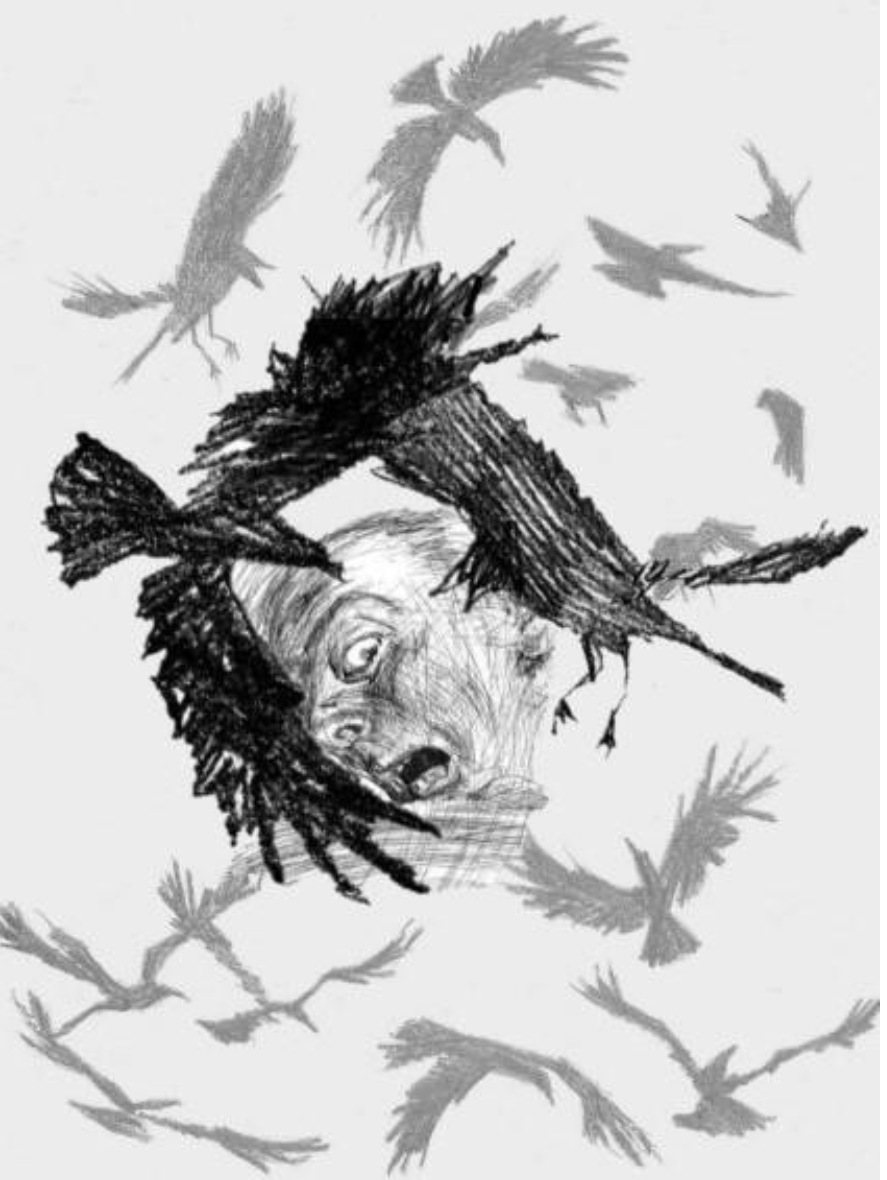
The birds left the bodies and circled around me, swooping low and crying out. Then they lined each side of the path and watched me. They were very still.
Growing up in the ranchita there were daily beatings by the kids in the village. My mother would wipe off the blood and ask my older sister Iurhi why all the kids picked on me. She usually just shrugged but once managed, “Cause everybody knows about Tomas, mom.”
“Know what?”
She just shrugged again. I kept my mouth shut. Very. No one messed with Iurhi. Small, hard and fast, she could have easily beaten back my tormentors. She knew better than to try. In our town the shame of a sister bodyguard would have only made things worse for me. We kept their distance from each other. For me it was like waters under a frozen river. Family and pride coursed beneath everything. Sometimes a bubble rose up, bounced against the ice like a pearl off its string. Her looks startled, and hurt.
I wrote an X for my name. You felt lucky if I gave you a blank smile, or a grunt.
I cut sugarcane with hate power. I drove my uncle’s poultry truck before I could see over the steering wheel. I didn’t read, write, talk or understand clocks. Cabeza hueco. Hollow head. But I was the only one who could pop the clutch just right, jerk the heap up out of ditches and mud and stalls. People asked me how I did it, I just mumbled, lucky with junk. It didn’t mean anything.
No one argued.
I perfected the guise of silence into a wary languor, then an impenetrable armor. My tormentors fell away from boredom; my exasperating indifference made beating me as satisfying as torturing a brick. My stealth reached the heights of art. I defied physics into invisibility, achieving an absence of mass. The silent one in the shadows. Eating shadows, made of shadows, all the while plain and simple as anything, or nothing. But if you looked closer I wasn’t there.
Not just nobody special, or nobody normal. Nobody nothing. When I started to read and write it was everything, in English and Spanish, things I shouldn’t have understood, and all at once.
I hid the books.
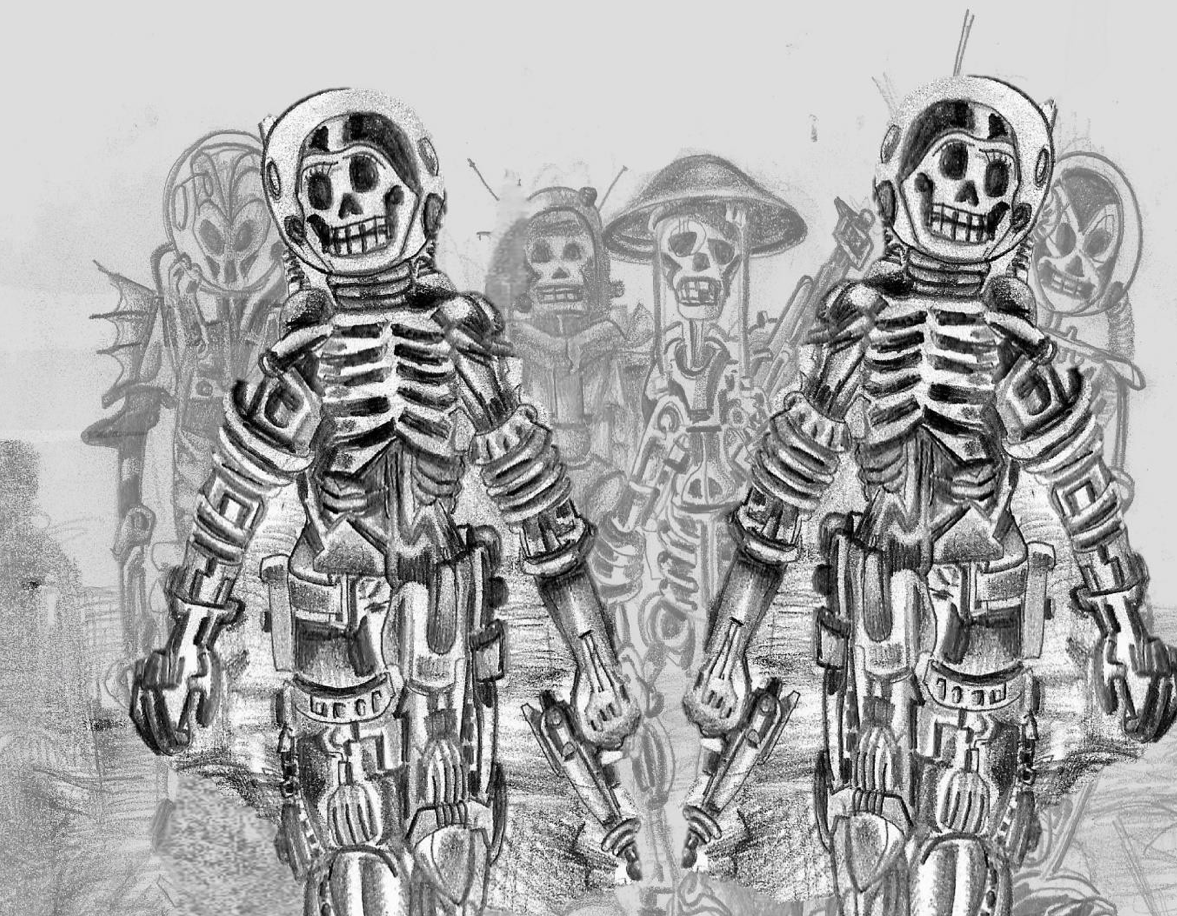
At night in secret I went to the shed to read and make tiny Calaca sculptures by lamp light from clay, and scraps of wood, wire and junk. The skeletons were in various contemporary settings I reconstructed from magazines, such as tiny health clubs, or office cubicles with computers. I gave them to my cousin to sell at the local market, and we split the profits. I still signed all my work with an X.
My uncle Armando became a big man with connections. He said he wanted to help my family and gave my mother money. I was allowed to leave the fields and work on my sculptures. When I turned twenty Armando offered me a big chance as a traffic cop. The job came with a squad car and siren, and a black uniform, with a black leather holster and a black gun. I dreaded it, but to refuse would have aroused the suspicion of others, so I agreed. If I brought in his share of bribes
(mordidas, “bites”), left the local cartel and gang alone, kept my uniform clean and my boots polished, there was a sure road to advancement. I could finally move off the stinking farm, help my mother, keep my sisters out of the maquiladoras and maybe be able to afford a nice place of my own. When I balked, Uncle Armando winked and said, “El que no transa, no avanca.” (He who doesn’t sell out, doesn’t get ahead).
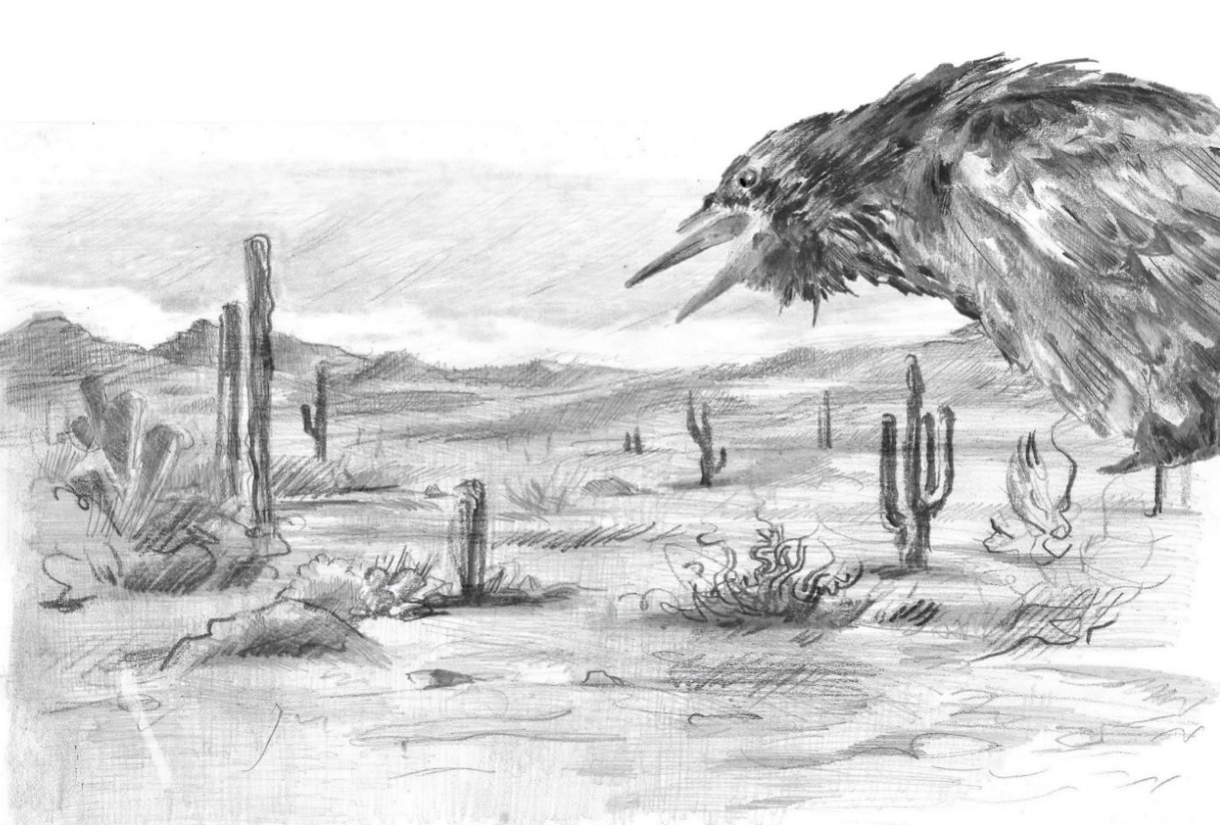
For a few weeks I dutifully wrote tickets and took the bribes, but it was too embarrassing, and I ended up in the empty foothills of the volcano, at a favorite spot up the road where three big boulders made a circle as if gathered for a story. I would sit on the big flat one in the middle and scratch skeletons and X’s into the rock. I shot at but missed ravens, crows, and sunning iguanas. I watched ants, running in and out of their tiny rooms like the bed-hopping characters of my mother’s daily telenovelas. I worked on my Calaca models. Slowly I gathered an audience of ravens and crows. They sat inches from me to preen each other and coo. The bigger ravens liked to lie down on the ground, right on top of the streaming ants, splayed out like sunbathers at the beach, their beaks pointed straight at the sun. They understood, before I did, that I could never shoot them. Their caws and dak-daks began to sound like well-meant advice. I’d take it, when I understood what it was.
I kept my head down. I quit the force and went back to the sugar cane, making my wood and clay skeleton models at night in the shed, and reading. I did a whole series of skeleton policemen in gunfights, and bad guy skeletons being set upon by ravens I made the birds with paperclips and my own hair. On a visit to the dumpsters behind the factory I brought back a bonanza of old circuit boards, and created a new line of robot Calaca, half skeleton, half cyborg. I decided to put them on sale again, and boxed them up for Julio.
On a moonless night as I locked the shed I was struck from behind. I shrank into a fetal crouch, as I’d done many times before. I tried to cover my head, but they kicked at it, paid special attention to my head, and my ribs. And the box of my sculptures. I heard the crunch and snap of the skeletons, and my own bones. When they were finished and gone I passed out. I couldn’t remember how he got there but I woke on our kitchen floor. The door to the house was kicked in, and when I dragged through the house my mother and sisters were gone. All the lights were on, and the house was trashed. My mother’s purse was still on the bed. She would have never left on her own without taking it.
I called my uncle Armando for help. Armando promised to come over but I guess I passed out again and didn’t see him until he came to in the morning.
Armando said, “You a mess.”
Armando helped me to his truck and drove me to the police station, where my former captain told me there would be a full investigation and search. But first, he said, there was the matter of the drugs. I had trouble sitting up, and breathing. I said he knew nothing about the drugs. I had called the police and they’d taken them, and the body, away. Everyone knew that. But what we don’t know, the captain said, is what happened to that kilo of coke? I looked from my uncle to the captain and back again, searching for help, then sense. Their eyes were a blank, hard show, the eyes of bad movie actors. I understood the drugs had been stolen, and I was to be blamed.
The captain told Armando to leave the room. When they were alone he said, “Your mother and sister are fine. They had to leave for their own safety. When we recover the drugs we can get you to the doctor, then bring tu madre y tu hermano back to you. You’ll all be happy again. You’d like that, wouldn’t you? For their sake, tell us where the drugs are.”
“I hurt.”
“You think this is hurt?” The captain took his stick and poked me in the side. The pain put me on his knees. “Why did you quit the force, motherfucker? Did you think you’d be all set for life now, once you cut that dope and put it on the street? Did you? But you couldn’t have moved it all so fast. Where have you hidden it?”
There were more pokes, then blows. I went extra-invisible, and gone.
I was in and out. Then out out. For a long time I looked out from the stone floor of a cell that dipped into a rusty drain. Then the floor was swept with shadows like brooms. The drain glowed like pearl, turned to brass, bronze, gold. Birds were casting the shadows. My ravens were back.
We like you in black. Crooooaak croooaak. We’ll help you. Gronk-gronk. Come back to the mountain in black. Tok Tok Tok. In uniform, now! Don’t Wait! Wonk wonk.
A metal door slammed in the distance. I woke splayed on a bare mattress that smelled bad. My shirt was gone and I was wrapped in bandages over my ribs. I had to roll to sit up and flipped off the bed, but found a position on my side on the floor where I was able to breathe.
Across the cell was the captain. He asked me if I was ready to talk.
“Don’t thank me for getting you patched up. I have a big heart.”
I leaned back against the bed frame and took ragged breaths until the pain eased.
Oh, sorry,” the captain said. “I forgot. Usted es el gran silencio Senor! Big Mister Silence.
Use sign language, asshole. Tell me about the coke.”
“Where’s my uncle Armando? He’s the one that knows.”
“Now you’re turning on tu querido Armando? He’s the only reason you’re not dead now,
Tomaslito. Leave him out of this.”
“I’ll take you to the drugs. I buried them. Up the mountain. You give me back my uniform, and my gun, and car. I’ll drive there and you follow me.”
The captain spit on him and laughed. “Why should I do that?”
The gob of spit sat on my leg. “You want the drugs.”
“You are a crazy fucked piece of shit, but all right.” The captain left, and returned with a uniform, boots and a gun. He tossed the bundle on the bed. “It’s unloaded, Officer Asshole.”
“I don’t need bullets.”
The captain shook his head and laughed. “You’re going to wish you had one for yourself if this doesn’t go right.”
Had there been a landslide? The road shrank to a trail, a path, a trace, a chance. It was too narrow to turn, too late to turn back. On my way to certain death the crunch of shards and scree, and the churn of dirt stirred to dirge my shift to first. This would be my dust keen. But why wait for a hymn? I stepped on it, sped the droning road to whine. The captain and his two men, Beto and a guy I didn’t know with an expensive haircut, kept up fine. I barely recognized the way; it looked taken over by the mountain and the wind. But we wound their way there, to the turnaround with the three big boulders. I parked and opened the door to reach down for a bit of gravel. I took off my hat and marked the top of it with an X drawn with the chalky stone. I pulled the hat back on my head tight. I told the captain and his men the drugs were buried behind the big middle boulder, and the captain dropped a shovel at my feet and told me to get to it. I took the shovel and made a show of triangulating off shadow and stone, pacing out a secret find not there while the men looked for shade, lit up cigarettes and passed a sweating bottle of Corona.
Beto sang an army song about Juan’s sister. The nameless guy drank and smoked and flipped through his phone, looking cool.
I finally settled on the exact location of nothing. The shovel edge glanced off a skosh of gravel. The captain spat and barked for me to get serious. My side was agony but I leaned in and thrust deep just as the first shadow streaked over the ground. The raven returned to dip and hover just over Beto’s head, casting a dash of shadow on his shoulder and doing a dagger dance of shadow around his feet. Another bird, a smaller crow, came straight out of the sun so it was almost not there at all, silent and almost motionless. All three cops blinked into the sky and stepped back. They drew their guns. The captain had heard the story of the cartel men torn apart by birds. He aimed his gun at me. “Keep digging or you’re dead.” I stabbed at the ground, drenched in sweat and my slick hands frozen afraid and sliding into splinter.
Then the rest of the birds fell in a thumping black rain, like stories from the Bible of black things out of the sky. Giant locusts. Dead things. Shoes or bloody keys or hailstones of mud, and hair. No. dead birds. They hit the ground dead atop the ants again. I almost screamed, this is no time to sunbathe! But then they sprang aloft, not dead. But silent. An un-death sort of life, flailing, raking wild, all-in silence save the flapping in fever air. I’d never seen so many ravens, or crows, rooks, black birds, whatever they were, soundless, and with eyes too bright, with the glow of black-light LED’s. The scribble cloud of them ensnared the cops. The captain and Beto got off some rounds and killed some of them, but they just kept coming. I couldn’t even see the nameless guy. I watched it all from behind the boulder, on my stomach, pressed into the ground. First I covered my head, but the birds paid no attention to me at all. They closed around the cops, the captain and Beto quickly on the ground, covered in black feathers and blur of wings. And in the center was the first bird, the largest crow I’d ever seen, and white, its amber beak cocked up out of the melee, bright red and busy with gristle. What yanking ardor!
I waited on the ground until the flapping and the screams were over. The captain and Beto’s uniforms were pin-holed to a delicate shred, like doilies of black lace. I followed a blood trail soaking into the dust, black as chocolate sauce. I found the nameless guy hanging half out of the squad car, empty eye sockets blank and cool like beady shades from an ‘80’s action film.
Soon there’d be more police. And my uncle. Tio Armando was ambitious. His absent father’s brother, always after Tomas’s mother. The big man of the ranchita. He’d been north and come back even bigger. He always talked big plans for me. Why this set-up, I couldn’t say. It was all so stupid. All I ever wanted was to be left alone, here in the mountains would be fine, make my Calavera sculptures and dream bigger than the USA, bigger than the world.
My side hurt bad. I couldn’t breathe without pain, and my head was splitting open. Move.
Find my mom, and Iurhi. And Lucia. And my cousin. Julio had friends in Corpus Christi, Santa Fe, and Las Cruces. He said they could make a living there selling my shit at fairs. Authentic folk art. Not the robot shit, man. Keep it in the barrio. Skeleton mama rolling out tortillas, Skeleton Iurhi smoking while teasing out a quiff.
Move.
But I could only ease to the ground and clutch my pounding head. I couldn’t, I wasn’t going to get out of this. I wasn’t smart. I wasn’t anybody.
My last chance to be real, vato.
Move.
I tottered to my feet. Brambles cracked under my boots in a stagger to the car. The pain clawed back at my spine, sent it into a twist, and I saw my own body mirrored back across the road and over the plain in a giant maguey plant of grey green, gnarled tentacles, overgrown and knotted into surrounding tufts of mesquite and nopales cactus, like a collar of green steel wool drawn up against the wind. I was dreaming on my feet. The foliage made serpent moves and a fan dance shiver. White fog billowed around my ankles. A rush of wings and then silence behind told me and I was on my own again. The sky darkened. I heard crunching footsteps and turned.
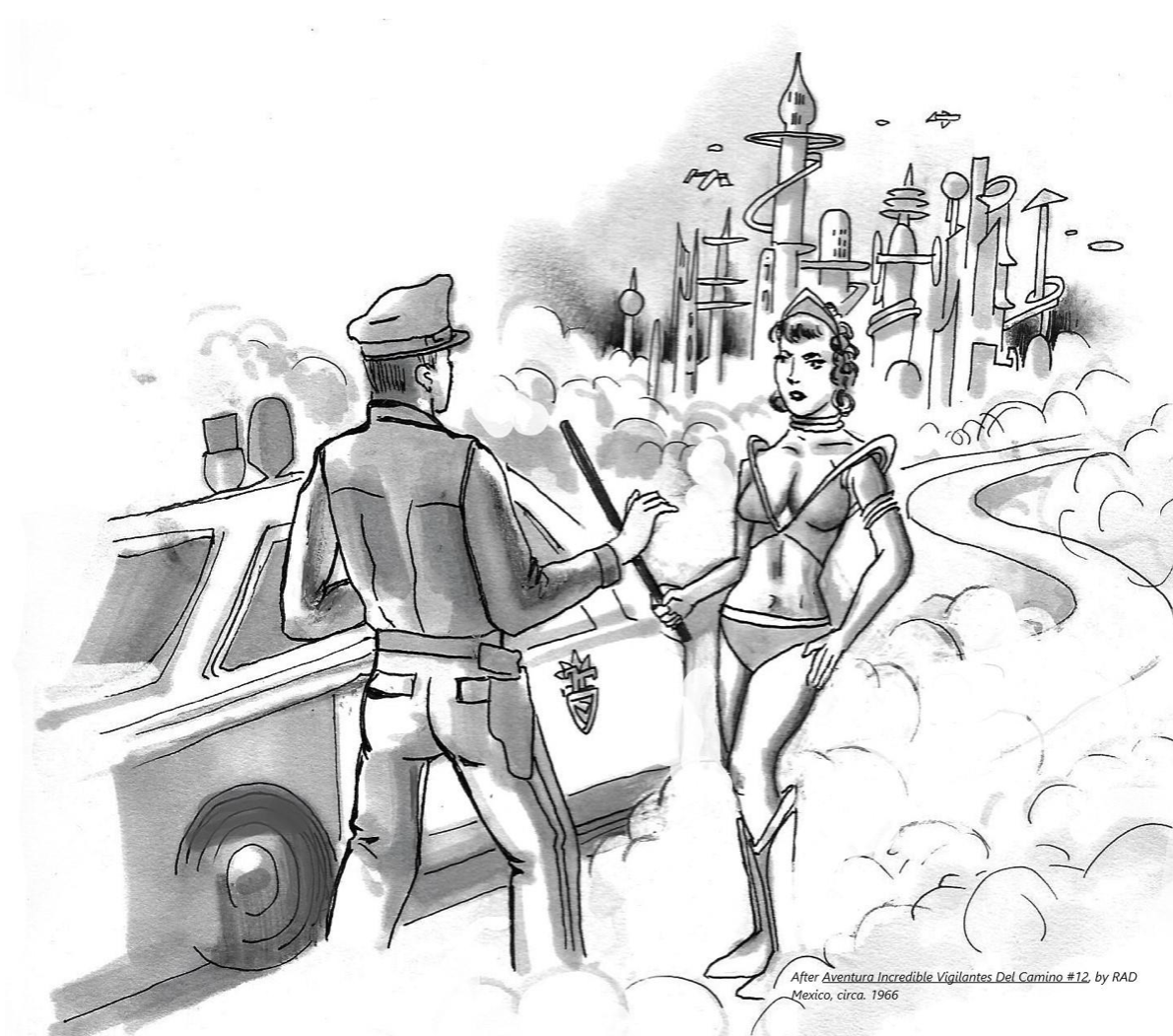
Before me was six-foot-tall woman in a red and gold bikini and a red and gold tiara, her height amplified by a piled up hair-do, white and gold high heel go-go boots and an expression of regal disdain that sharpened to menace as she stepped forward. She held out a thick staff toward my chest and hissed a foreign command.
I saw over the woman’s shoulder gold spires and domes of a futuristic city, sparkling out of distant clouds.
Drone-like vehicles buzzed through its arches and sky walkways. Her super city home! I felt a glow of peace and looked back at the woman, who glared down at my gun and then back at my face with loathing and rage, like I’d squeezed out a turd at her feet. The stick came down on my shoulder and arm and I stumbled, trying to shield my face and head. But my busted ribs
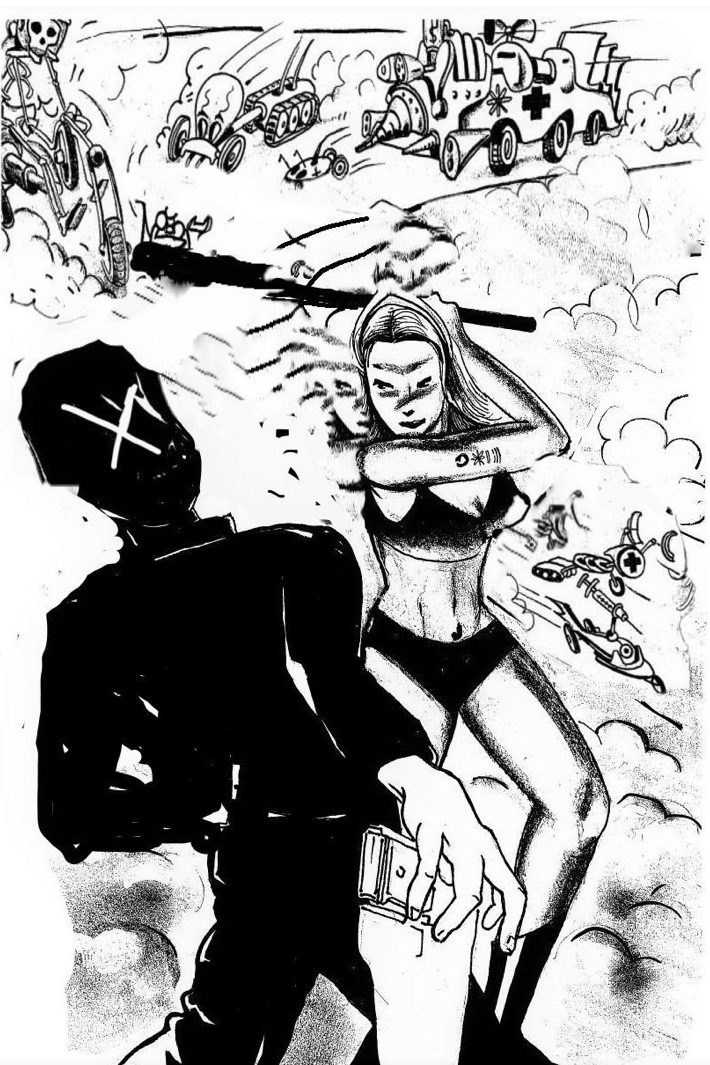
constricted my reach and I could only crouch down and take the next blow with my head, and back. Staggering I took another blow and another, on the ground and full in the face, before a black-out plunge into white freezing cloud shut me down.
With my other senses off, my hearing stayed acutely tuned to every nuance, from the meaty thunk of the baton splitting and smashing my skull to the bright crack of bone, blubber of blood and splong of popped eye balls. My dying senses set off a gurgling twang, like guitar strings snapping under water. Behind it was an acid yellow sonic undercoat of trill, whoop and yowl— emergency sirens climbing up the mountain, to me. Though my eyeballs seemed to be dangling loose on distended threads of muscle, my vision returned with the wails, and I could see the woman again, and an approaching parade of silver vehicles coming out of the fog and dust.
Even as the Go-Go amazon was whacking me with her stick, some weird tenderness stole over her face. Then her baton just dropped. She disappeared behind the huddle of ambulance machines, brilliant silver robot pods and chassis on treads, jostling like eager rubes for the best view of the geek, me. They shivered and gawked over me on spindly spoked tires, insect legs and unicycles gyro-ing balance in weaving sway. Silver skeleton drivers purred from within and scanned through the settling dust.
A fat hologram Red Cross detached from one skeleton’s forehead and floated over my body, bathing me in scarlet light. From far away I knew I was flat-lining, but with potential. The Red Cross hopped back onto the skull, and green tinted canopies in the vehicles hissed open and issued arrays of surgical automata on a synthetic-scented breeze. Defibrillator probes zapped, and I felt a beat. I was massaged by whining articulations of white plastic and silver metal, coddled and trussed in magnetic suspension harnesses, shot up by syringe-tipped tentacles and sliced open by laser scalpels glowing white, and blue. Delicate gold mandibles coaxed battered skin, and tongs spread the smoking incisions wide. Vacuum snouts chortling like the suck of draining straws suctioned blood and bone debris clear. Pearl polymer hands of nine fingers with six digits each tucked bladdered implants, and coaxed amber prosthetics deep into my now semi-corpse, reassembling and fusing shattered bone with synthetics. Squashed organs were replaced with animal-human hybrids, vat bred tissues, or all-machine pods. Then beetle surgeons cauterized, and spider web spray staunched, with platelet powder sealing it all in a pixie-dust puff. The machines rinsed off the remaining blood, viscera and dust off my body, quickly showing a baby flush. Then they cleaned their own instruments, and the surfaces of the medical mobiles. Defibrillator implants chimed and found their rhythm. I gasped, coughed, and breathed, slow and easy. The bustle of digital alacrity stilled, and all was a sparkling, humming sheen.
Through all of it I never felt a thing.
I was taken to the city of Nepantla and, after a brief recuperation, toured its many attractions outfitted in a powder blue jumpsuit with white boots. I was guided amiably by the tall blond woman who had beaten me to death and back. Her name was Xandra. In this cloud city I floated on a pain-free cloud. I walked through the streets as if freshly flayed.
I interrupted a tour of the marketplace of floating fruit to ask, “Why did you hit me over and over?” Xandra kept walking. She said, “You will observe that our fruit is not only delicious and colorful but performs gay dances in the air. Each succulent follows a different pattern, and rhythm. Similar species fly in groups, while unlike varieties trade off, mirror, counterpoint, or even collide. We try to minimize this to avoid a rain of juice and pulp falling on the shoppers below.”
I tried to attend to the spirit of the tour. “What happens after these flying fruits have been ingested?”
“We dance inside, and you, in time, will join.” Behind and above her, my murder of crows were assembling for another feast. I traced an X in the dirt and stood in its center, smiling at the sky.
Gregg Williard is a writer and visual artist in Madison, Wisconsin. Some of his recent work can be found in Propogule, The Belletrist, Gossamer Wight, 100 Subtexts and elsewhere. His website is Williardart.com